Your essential-load list.
Choose the devices that matter and how long you intend to use each one.
THE STILLPOWER HOME BACKUP POWER KIT
Know what you want to keep on, estimate the battery capacity you need, and put your household’s next steps on paper.
An illustrated guide and a practical notebook to help you choose and plan around rechargeable backup batteries.
$30 USD · One-time paymentGuide + notebook + future companion guides and updates
Download the complete kit after payment.
The free sample needs no email or payment.
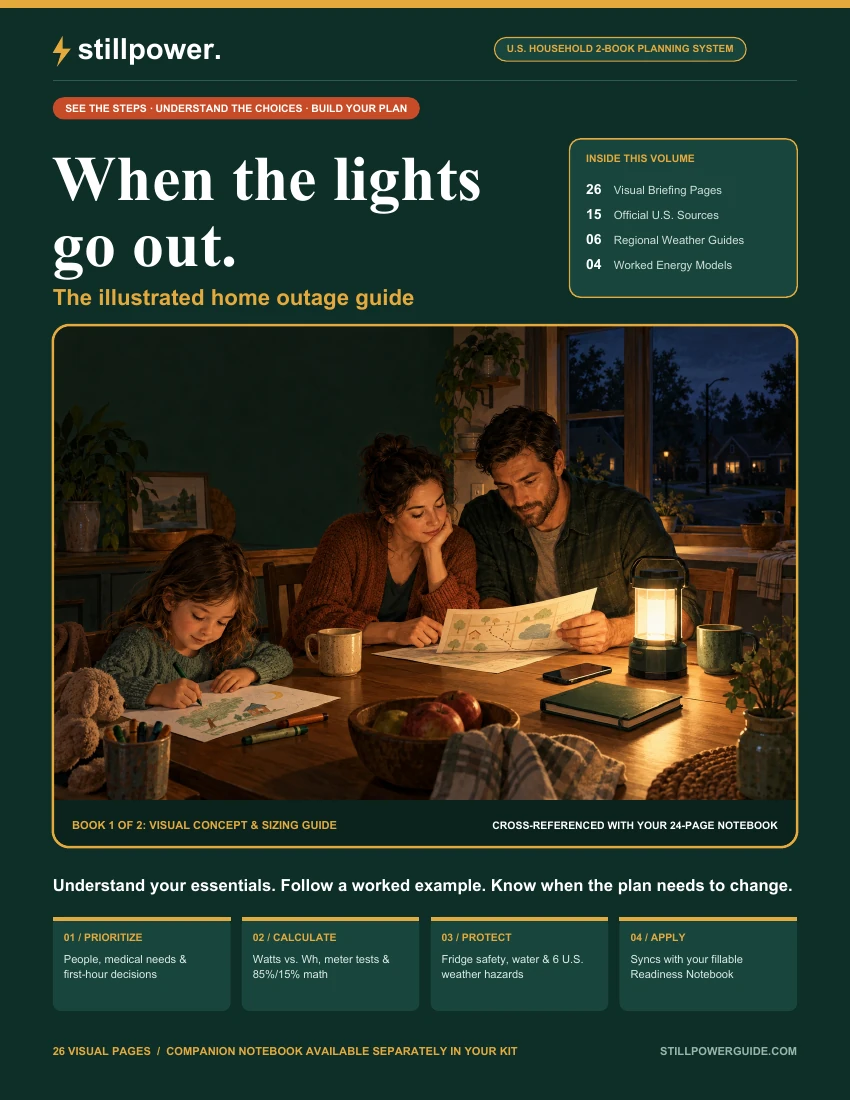
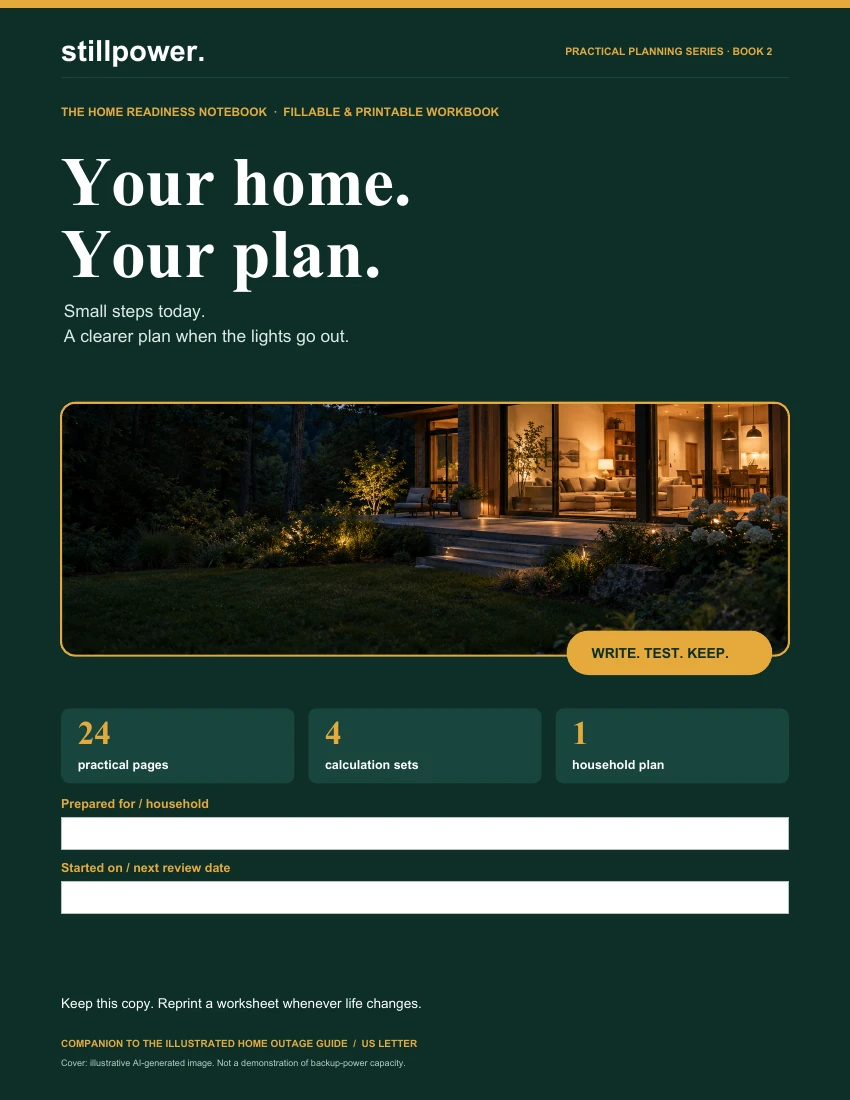
Choose the devices that matter and how long you intend to use each one.
Work through the numbers, state your assumptions and check equipment requirements.
Keep contacts, responsibilities and fallback arrangements together on paper.
BEFORE YOU CHOOSE A BACKUP BATTERY
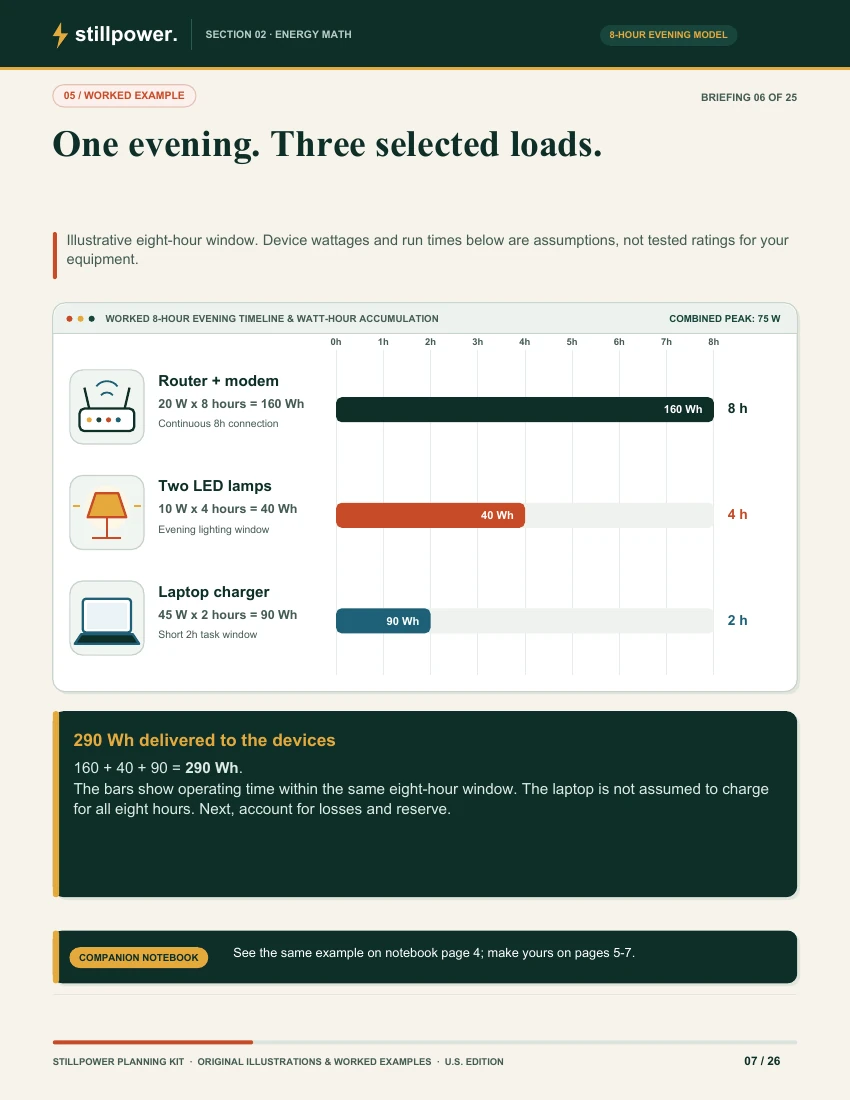
Start with a small, defined situation. This teaching example covers a router, two lights and a laptop during an eight-hour evening.
Illustrative wattages and operating times. Use readings or suitable documentation for your own equipment.
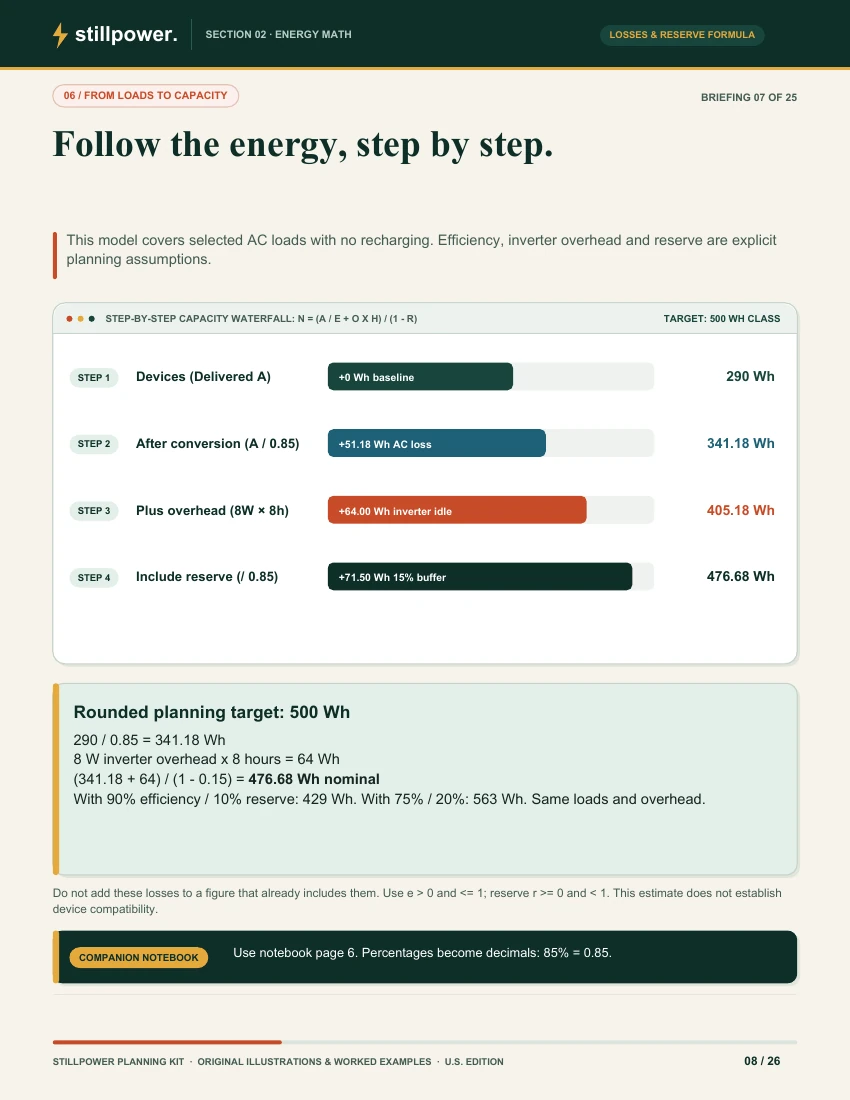
Assumptions: AC conversion efficiency 85%; inverter overhead 8 W for 8 hours; reserve 15%; no recharging.
Use unrounded values until the final step. With 90% efficiency and 10% reserve, the same loads and overhead need about 429 Wh. With 75% efficiency and 20% reserve, they need about 563 Wh. Avoid counting overhead or conversion losses twice.
All three devices together draw 75 W. Powering a router cannot restore a failed internet provider connection. This example does not include a refrigerator, heating or a full 24-hour day.
Try your own inputs in the free calculator →WHAT COMES WITH THE KIT
Use the guide for explanations and worked examples. Choose one notebook edition to record your own decisions.
26 pages · Visual reference PDF · US Letter
See how watts, watt-hours, measurements and battery capacity fit together. Follow a worked evening example, then see how a refrigerator and longer outages change the plan.
24 pages · Fillable and printable PDF
Make your own essential-load inventory and capacity estimate. Keep an equipment checklist, recharge record, budget and household action sheet in one place.
Color or low-ink, each in US Letter and A4. The worksheets are the same in every edition. Each notebook has 328 fillable fields; calculations are manual.
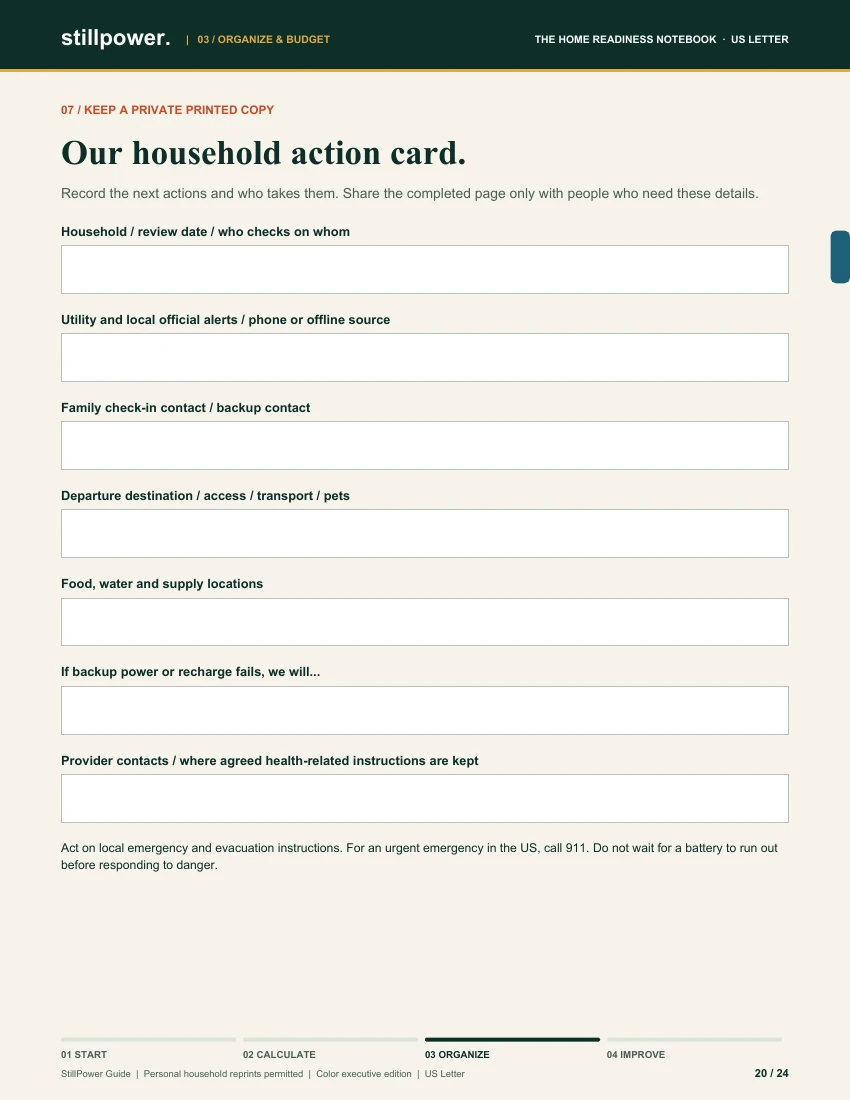
THE RESULT YOU CAN KEEP
Bring together the people to contact, places to go and arrangements your household needs. Keep the completed sheet somewhere everyone can find it.
Actual notebook page shown. Household details stay in your own PDF or printed copy.
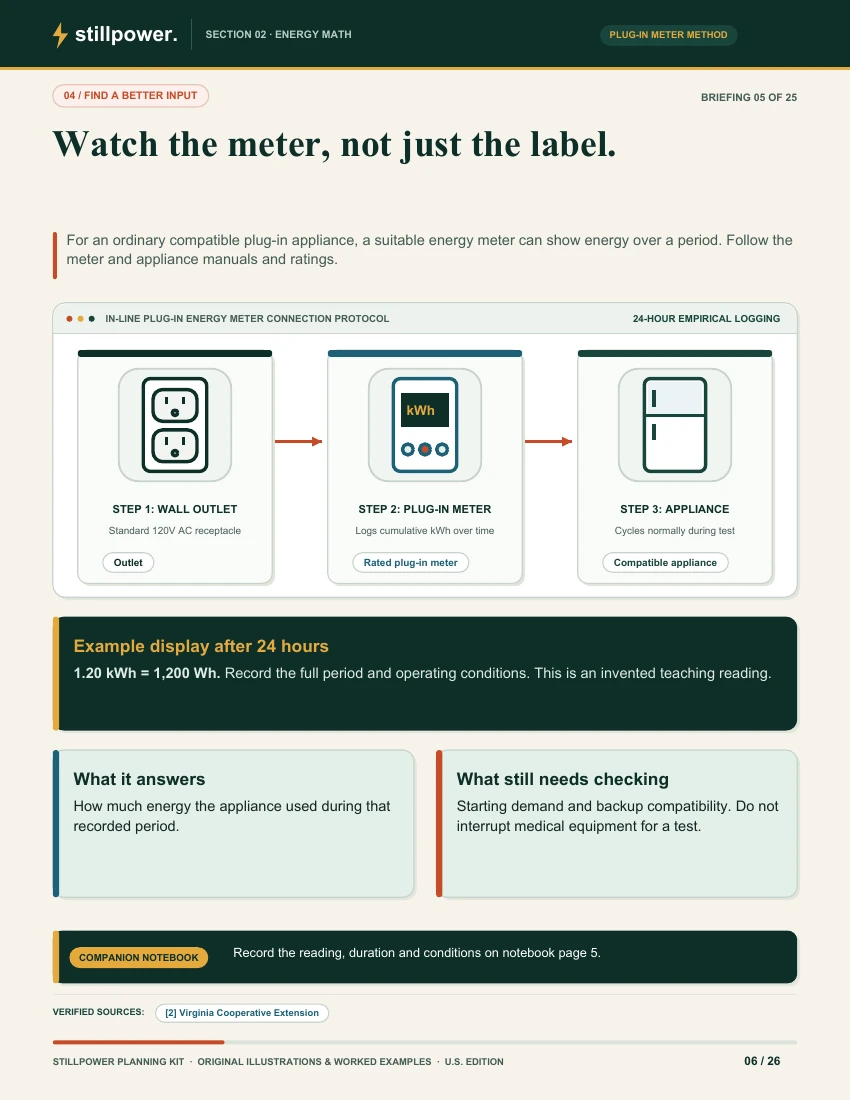
LOOK INSIDE FIRST
The four-page sample includes the cover, the plug-in meter example, the evening energy example and the hurricane planning page.
Open the 4-page sample PDF ↗Free · No email required · No payment required
INCLUDED BEYOND THE FIRST DOWNLOAD
Follow Backup Power Notes for planning ideas, solution research and announcements of new kit material.
Explore the update feed →A public update feed with occasional notes on backup power, rechargeable batteries and household planning. Read online or follow by RSS.
Future updates and companion guides for this kit are included at no extra charge when published. No fixed publication schedule is promised.
Future guides are an additional benefit. None beyond the current kit have been released yet.
THE COMPLETE STILLPOWER KIT
For households planning selected essentials during a power outage, or checking what they need before choosing a rechargeable backup power station.
Digital educational materials. No batteries, chargers or installation service are included.
$30 USD
One-time payment. No subscription.
Secure payment with Stripe. Return after payment to download your files and save your personal library link.
A FEW USEFUL ANSWERS
Yes. Pay $30 USD once through secure Stripe checkout. After payment is confirmed, return to StillPower to download the ZIP from your personal library. Save your library link for future access. Read the purchase terms.
The current kit contains the illustrated guide and the notebook in four editions. After purchase you can download all five PDFs. The four-page sample and update feed are free to everyone. Future kit updates and companion guides will be included in the purchase price when published. They are planned additions, with no fixed release dates or publication frequency.
The calculator estimates capacity and lets you download your inputs. The kit adds visual explanations, reusable worksheets, equipment checks, a recharge record, a budget and a household action sheet. Its value is the connected planning process; the calculator remains free.
Open the free calculator →No. The notebook has fields you can type into, but the calculations are manual. Use a compatible PDF reader, save your copy and reopen it to check your entries. You can also print individual worksheets for personal household use.
The 500 Wh figure belongs to one illustrative eight-hour evening with three selected loads. It is not a whole-home or 72-hour runtime promise. Your loads, operating time, equipment, losses and charging opportunities determine your plan. Check startup and output compatibility separately.
This kit focuses on planning around rechargeable backup batteries and power stations. It does not teach battery repair, cell replacement, home wiring or installation. Other areas of StillPower discuss independent courses separately.
The guide uses original diagrams and worked examples with 15 linked public guidance sources, including the American Red Cross, CDC, FDA, NOAA/NWS and Virginia Cooperative Extension. Those organizations do not sponsor or endorse this kit.
Follow current official emergency instructions, manufacturer limits and provider-approved medical plans. The kit does not certify equipment compatibility.
Bookmark Backup Power Notes, or add its RSS address to your feed reader. The feed is public and does not require an email address. New companion guides will be announced there as they are published. Customers can download included releases through their personal library link.
Follow Backup Power Notes →ONE USEFUL STEP TODAY
Start with the pages. Decide whether the approach fits your household.